The subsurface in Oceanside typically consists of sandy terrace deposits and silty clays from the San Luis Rey River floodplain, with groundwater often sitting 4 to 8 feet below grade in low-lying areas. These conditions demand careful soil stabilization for roads before any pavement section is placed. Without proper treatment, the loose sands and expansive fines can lead to differential settlement and early cracking. That is why our lab integrates a full granulometryanalysis with Proctor compaction curves to define the optimal moisture-density relationship for the borrow material.
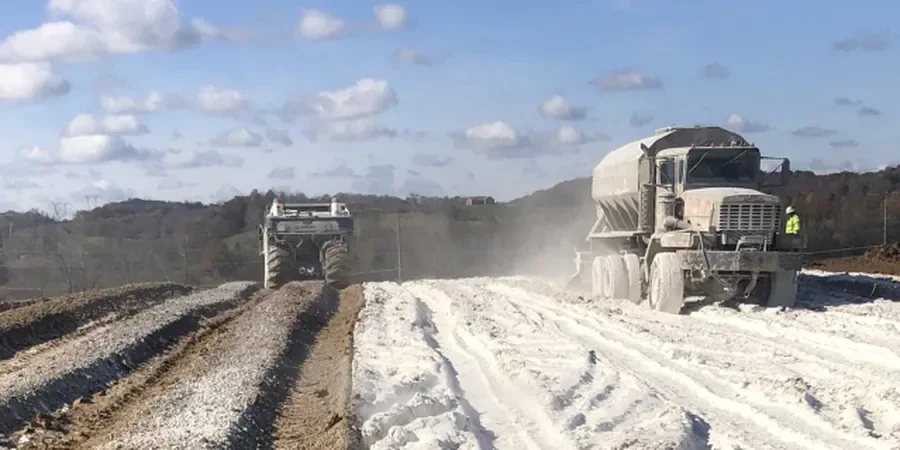
Treating the subgrade with cement or lime at 3-5% by dry weight typically raises the CBR from 4-6 to over 20.
Method and coverage
- In-situ moisture conditioning to near optimum (ASTM D698)
- Uniform binder spread and deep tilling (rotary mixer)
- Immediate compaction and 7-day curing before the base course
Regional considerations
Oceanside has seen steady urban expansion since the 1980s, with residential subdivisions and commercial corridors pushing into former agricultural land along the river terraces. Much of this fill was placed without engineered compaction oversight, creating pockets of low-density material that now underlie roadways. If soil stabilization for roads is skipped or done superficially on these legacy fills, the result is uneven settlement, pavement fatigue, and costly maintenance within the first five years. Our team has investigated several post-construction failures in the College Boulevard corridor that trace directly to inadequate subgrade treatment.
Standards that apply
ASTM D698 (Standard Proctor), ASTM D1883 (CBR test), ASTM D4318 (Atterberg limits), Caltrans Standard Specifications Section 19 (Soil Stabilization), IBC 2021 Chapter 18 (excavation, grading, and fill)
Complementary services
Laboratory Mix Design for Cement/Lime Stabilization
We determine the optimum binder content by running CBR, unconfined compression, and pH tests on representative samples from your project site. The result is a mix design report that specifies the exact dosage, moisture range, and curing requirements for your soil type.
Field Quality Control During Stabilization
Our technicians perform in-situ density testing, moisture checks, and witness the binder spreading and mixing process. We issue daily reports with compaction curves and CBR verification so you can approve each layer before the base course goes down.
Typical parameters
Top questions
How much does soil stabilization for roads in Oceanside typically cost?
For a standard 12-inch treatment depth, the combined laboratory design and field QC solutions range between US$720 and US$2,850 per project. The final cost depends on the number of samples, the binder type (cement vs. lime), and the frequency of field tests required by the engineer.
What is the difference between cement stabilization and lime stabilization for local soils?
Cement works best on sands and low-plasticity silts (PI < 15), providing rapid strength gain within 7 days. Lime is preferred for high-plasticity clays (PI > 25) because it first reduces the plasticity index through cation exchange, then develops strength over 14–28 days. We run Atterberg limits and pH tests to recommend the correct binder for your specific soil.
How long does the stabilization process take from start to finish?
Laboratory mix design typically takes 5–7 business days after sample delivery. Field treatment and compaction can be completed in one to two working days for a typical road section. The 7-day curing period follows before you can place the base course, so plan for about two weeks total from lab to final approval.