The difference between building on the marine terraces near the Oceanside Pier and the alluvial flats along the San Luis Rey River is night and day. On the terraces, you get competent sandstone near the surface. Head inland toward the river valley, and you're dealing with soft, saturated silts and sands that amplify ground motion. That's exactly where an HVSR microtremor survey becomes essential. This passive seismic technique measures ambient vibrations to determine the fundamental resonant frequency of the soil column. It tells us how the ground will behave during an earthquake without drilling a single hole. Before we run any active source testing, we often pair the HVSR data with a resistivity survey to cross-check stratigraphy and with seismic tomography for shear-wave velocity profiles. The combination gives us a complete picture of the subsurface in Oceanside.
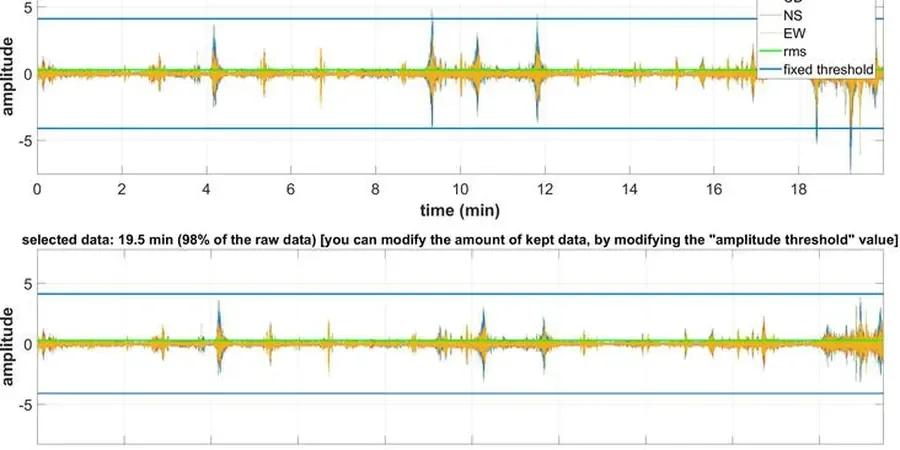
A low fundamental frequency below 2 Hz in Oceanside signals deep, soft deposits that can amplify seismic waves by a factor of three or more.
Method and coverage
Regional considerations
ASCE 7-22 requires site-specific ground motion analysis for structures on Site Class F soils or where amplification factors exceed standard code values. In Oceanside, the risk is highest along the San Luis Rey River corridor and low-lying areas near Buena Vista Lagoon, where thick deposits of soft alluvium and artificial fill can amplify long-period motions. An HVSR microtremor survey identifies these zones quickly. Without it, you might assume uniform conditions across the site and under-design for resonance effects. That's a liability we help you avoid. The data gives us a defensible basis for selecting design spectra and avoiding the common mistake of treating all coastal soils the same.
Standards that apply
ASCE 7-22 Section 11.4 (Site Class Determination), IBC 2021 Chapter 16 (Seismic Design Requirements), SESAME 2004 Guidelines for H/V Spectral Ratio Processing
Complementary services
Single-Station HVSR Survey
Rapid reconnaissance using one seismometer per location. Ideal for preliminary site screening, identifying soft zones, and estimating fundamental frequency across large areas. Deliverables include H/V curves and site class recommendation per ASCE 7.
Multi-Station Array HVSR Survey
Deployment of 5 to 10 stations simultaneously across the site for spatial variability mapping. Provides a 2D profile of f0 variations, helps locate buried bedrock channels, and supports detailed seismic response analysis. Includes full report with interpreted cross-sections.
Typical parameters
Top questions
What is the fundamental frequency measured by an HVSR microtremor survey and why does it matter in Oceanside?
The fundamental frequency (f0) is the lowest natural frequency at which the soil column vibrates. In Oceanside, values below 2 Hz are common near the river valley, indicating deep, soft sediments that can amplify earthquake motions. Knowing f0 helps engineers avoid resonance between the ground and the building, which can cause structural damage.
How does the HVSR method compare to drilling boreholes for site characterization?
HVSR is passive and non-invasive—no drilling, no noise, no access restrictions. It measures ambient vibrations from traffic, wind, and ocean waves to infer soil properties. Boreholes give direct samples, but HVSR covers more area per dollar and identifies resonant behavior that drilling alone cannot. We often use HVSR first, then target boreholes based on the results.
What are the typical soils in Oceanside that require an HVSR microtremor survey?
Oceanside has a mix of marine terrace deposits (dense sands and sandstone) near the coast and alluvial soils (soft silts, clays, and loose sands) along the San Luis Rey River and inland valleys. The alluvial areas are prone to seismic amplification, making them ideal candidates for HVSR testing to quantify site response before design.