A common mistake we see from builders in Oceanside is assuming all sandy terrace deposits behave the same under load. They pour a slab, then watch it crack months later when winter rains hit. That sudden settlement — sometimes several inches — comes from collapsible soil that looked perfectly stable when dry. The structure of these soils, often sands or silts with a loose meta-stable fabric, holds up fine until water breaks the inter-particle bonds. That is when the real trouble starts. We have mapped this behavior across neighborhoods near the San Luis Rey River and along coastal bluffs where seasonal moisture cycles are pronounced. Before pouring foundations, a proper collapsible soil evaluation should include controlled wetting tests and density measurements. Complementing this assessment with calicatas exploratorias helps identify the depth of problematic layers early on, while ensayo SPT gives a reliable baseline for penetration resistance in those same strata.
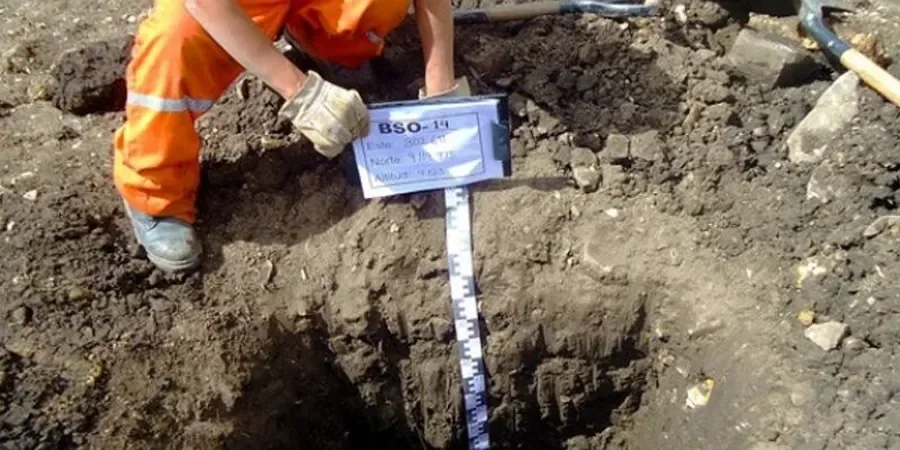
A collapsible soil evaluation in Oceanside must account for seasonal moisture cycles that trigger sudden settlement in meta-stable terrace deposits.
Method and coverage
- Double-ring infiltrometer to estimate wetting front advance in the field
- Modified Proctor compaction reference for site-specific moisture-density curves
- Collapse index calculation per ASTM D5333 procedures
Regional considerations
ASCE 7 and the California Building Code require site-specific geotechnical investigation for structures in areas with known collapsible soils. Oceanside falls within this category due to widespread terrace deposits and alluvial fans. The risk is not just total settlement but differential movement — one corner of a slab may sink while another stays put, leading to structural damage, cracked drywall, and misaligned doors. We follow ASTM D5333-03 for collapse testing and reference IBC Chapter 18 for foundation design criteria. In our background, ignoring the wetting collapse potential in coastal San Diego County has led to costly retrofits and legal disputes. A thorough collapsible soil evaluation identifies which layers need removal, compaction, or deep foundation support before construction begins.
Process video
Standards that apply
ASTM D5333-03 (Standard Test Method for Measurement of Collapse Potential of Soils), ASTM D1586-18 (Standard Test Method for Standard Penetration Test), ASCE 7-22 (Minimum Design Loads and Associated Criteria for Buildings)
Complementary services
Double Oedometer Collapse Testing
This controlled laboratory test measures strain at natural moisture and after inundation. We run it on undisturbed samples from critical depths identified during field exploration. The collapse index tells us exactly how much settlement to expect if saturation occurs.
In-Situ Density & Moisture Profiling
Using sand cone and nuclear density gauge methods, we map dry density and moisture content across the site. Low dry density combined with low saturation is a classic signature of collapsible fabric. We correlate these field readings with lab collapse results for a complete picture.
Typical parameters
Top questions
How long does a collapsible soil evaluation take in Oceanside?
A typical evaluation takes 5 to 10 business days from field sampling to final report. Rush timelines are possible for urgent projects.
What tests confirm collapsible soil behavior?
The double oedometer test per ASTM D5333 is the standard. We also run in-situ density and moisture profiling, plus sieve analysis to identify fines content. The collapse potential index from these tests tells us the risk.
How much does a collapsible soil evaluation cost in Oceanside?
The cost typically ranges between US$800 and US$2,690 depending on the number of test points, depth of sampling, and laboratory work required. We supply a detailed quote after reviewing the site plan.
Are collapsible soils common in Oceanside?
Yes, especially in areas underlain by loose terrace deposits and alluvial fans near the San Luis Rey River. These soils appear stable when dry but can collapse under load when wetted, making evaluation critical for new construction.