A few years back we were called to a site near the Oceanside Pier for a six-story mixed-use development. The geotech report from the 90s had classified the soil as "sand with silt" but offered no particle-size distribution. After running sieve and hydrometer tests on samples from 12 borings, we found that nearly 35% of the material passing the No. 200 sieve was clay-size — enough to change the foundation design from shallow footings to a mat foundation with drainage. That kind of detail is exactly why grain size analysis matters for Oceanside.
A single grain size curve can shift a foundation design from shallow spread footings to deep piles — we see it regularly in Oceanside.
Method and coverage
- Percentage of gravel, sand, silt, and clay fractions
- Uniformity coefficient (Cu) and coefficient of curvature (Cc)
- Fines content passing No. 200 sieve
- Hydrometer sedimentation curve for sub-75 µm particles
Regional considerations
In Oceanside, one of the most overlooked risks is the presence of collapsible soils in the eastern terraces. Without a proper grain size analysis, a contractor might assume uniform sand behavior and compact to 90% relative density — only to see the structure settle unevenly after the first wet season. The hydrometer component is the only way to detect the fine fractions that make these soils metastable. We flag this early to avoid expensive retrofits.
Process video
This service complements our laboratory testing work for a complete project analysis.
Standards that apply
ASTM D422-63 (Standard Test Method for Particle-Size Analysis of Soils), ASTM D6913/D6913M-17 (Particle-Size Distribution by Sieve), AASHTO T-88 (Particle Size Analysis of Soils), USCS classification per ASTM D2487
Complementary services
Mechanical Sieve Analysis (Coarse Fraction)
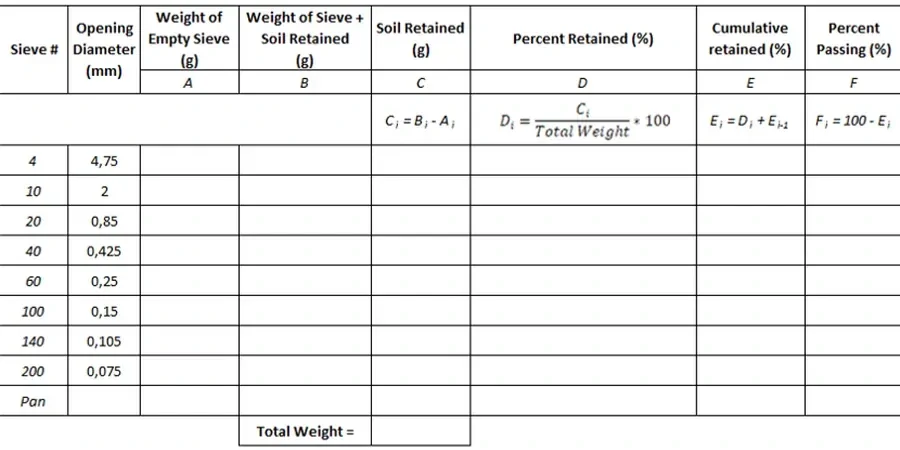
For sands and gravels typical of Oceanside's coastal zones, we run a full nest of sieves from 3 in to No. 200. Results include Cu, Cc, and percent passing each sieve. This method is ideal for fill quality control and aggregate base evaluation.
Hydrometer Analysis (Fine Fraction)
When fines exceed 12% passing No. 200 — common in Oceanside's inland alluvial soils — we perform the hydrometer sedimentation test to quantify clay and silt percentages. This is critical for liquefaction screening and expansive soil assessment.
Typical parameters
Top questions
How long does a grain size analysis take in your lab?
A standard sieve analysis takes 1 to 2 working days. If hydrometer is required, allow 3 to 5 days because the sedimentation readings span up to 24 hours for clay fractions. Rush service can cut the timeline to 48 hours.
What is the difference between sieve and hydrometer analysis?
Sieve analysis separates particles down to 0.075 mm (No. 200 sieve). Hydrometer analysis measures particles below that threshold — down to 0.001 mm — by tracking how fast fine grains settle in a water column. In Oceanside, we use both when the soil contains more than 10% fines.
How much does grain size analysis cost in Oceanside?
The price range for a combined sieve and hydrometer test is typically between US$110 and US$180 per sample. The final cost depends on the number of samples and whether you need ASTM or AASHTO reporting. We supply a fixed quote before work begins.