The difference between building a rigid pavement in the coastal flats around the Oceanside Harbor versus the inland clay terrains near Mission Avenue is night and day. Near the coast, we encounter loose sands and a shallow water table that demand careful subgrade drainage and a thicker concrete slab to prevent pumping. Inland, the expansive clay deposits require a different approach — controlling moisture variation and ensuring uniform support to avoid cracking. For any rigid pavement design in Oceanside, the subgrade modulus (k-value) is the starting point, and we determine it through plate load testing directly on the prepared subgrade. Without this data, the entire pavement structure is a guess.
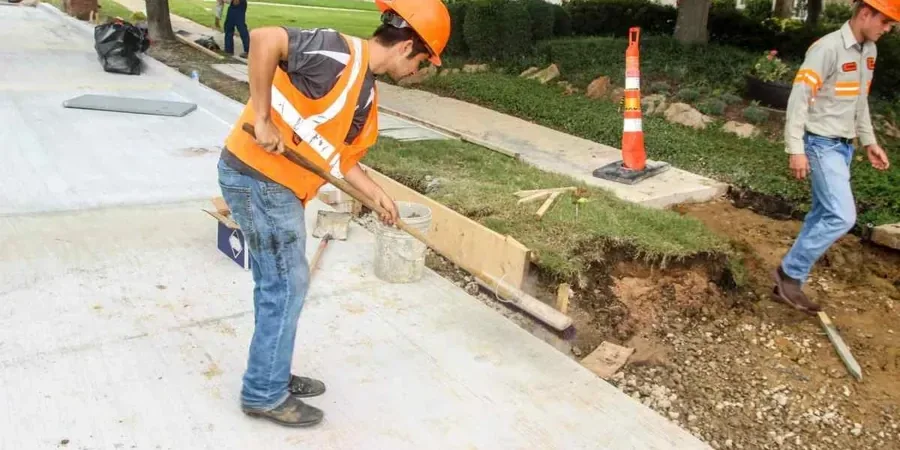
A rigid pavement in Oceanside requires knowing the k-value and the concrete flexural strength together — missing one means the design is incomplete.
Method and coverage
- Subgrade modulus (k-value) from plate load tests
- Concrete flexural strength (MR) at 28 days
- Joint load transfer efficiency
- Dowel bar alignment for heavy-duty sections
Regional considerations
ASCE 7 and the California Building Code (CBC) require that rigid pavements in seismic areas like Oceanside account for soil liquefaction potential and lateral spreading. The risk is real: during an earthquake, loose saturated sands beneath the pavement can lose strength and cause differential settlement or slab buckling. We evaluate the liquefaction potential using SPT data and cyclic stress ratios per the NCEER method. If the site is susceptible, the rigid pavement design must include a deep soil improvement layer or a thicker structural section to bridge the weak zone. Ignoring this risk can lead to pavement failure after a moderate seismic event.
Standards that apply
ASTM D1196 (Plate Load Test for k-value), ACI 325 (Rigid Pavement Design), CBC 2022 Chapter 18 (Soil & Foundation), ASTM C78 (Flexural Strength of Concrete)
Complementary services
Subgrade Evaluation & k-Value Testing
Plate load tests following ASTM D1196 to determine the modulus of subgrade reaction at multiple locations across the project site.
Concrete Mix Design & Flexural Strength Verification
Laboratory testing of trial mixes to achieve the specified MR, including shrinkage and durability checks against local aggregate reactivity.
Joint & Dowel Bar Design Review
Structural calculations for joint spacing, tie bars, and dowel bar sizing based on slab thickness and traffic loading.
Typical parameters
Top questions
What is the difference between rigid and flexible pavement for an Oceanside driveway?
Rigid pavement uses a Portland cement concrete slab that distributes loads over a wide area, making it more durable for heavy trucks but requiring joints to control cracking. Flexible pavement uses asphalt layers that flex under load and is cheaper but less durable. For a driveway in Oceanside with occasional heavy loads, rigid pavement is the better long-term choice.
How much does a rigid pavement design study cost in Oceanside?
The cost for a complete rigid pavement design study including plate load tests, concrete mix design, and joint layout typically ranges between US$1,950 and US$6,140 depending on the number of test locations and the complexity of the subgrade conditions.
What subgrade conditions in Oceanside affect rigid pavement design the most?
Expansive clay soils in the inland areas can cause slab heave if moisture changes, while loose saturated sands near the coast increase the risk of pumping and liquefaction. Both require specific design adjustments — thicker slab, stabilized base, or drainage systems — to ensure long-term performance.
Do I need a geotechnical report before designing a rigid pavement?
Yes, absolutely. A geotechnical report provides the subgrade k-value, soil classification, groundwater depth, and liquefaction potential. Without this data, the rigid pavement design cannot be properly sized or reinforced, leading to premature cracking or failure.