A common mistake we see in Oceanside is contractors pouring footings directly on undocumented fill without verifying its long-term behavior. They assume the fill is stable because the surface looks level. That assumption can lead to differential settlements of several inches within a few years. We have analyzed sites near the San Luis Rey River where fill depths exceed 15 feet, and the settlement potential was underestimated by over 50% in the initial design. A proper foundations on fill analysis must include compaction records, moisture-density testing, and bearing capacity verification. Before placing any concrete, we recommend a study of soil classification to identify whether the fill contains organic debris or expansive clays.
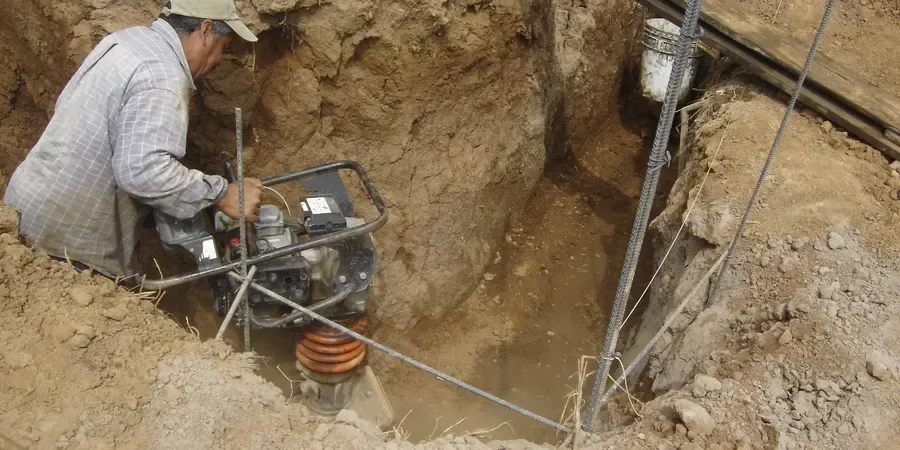
Uncontrolled fill in Oceanside can settle over 2 inches in five years; a proper analysis prevents structural damage that is far costlier to repair.
Method and coverage
- Boreholes with SPT per ASTM D1586
- Undisturbed sampling for consolidation testing
- Atterberg limits to detect moisture-sensitive fills
Regional considerations
We worked on a residential project near Oceanside Boulevard where the builder placed a 2,500-sf slab-on-grade over a 12-foot-deep undocumented fill. Within two years, the garage slab had dropped 3 inches at one corner, cracking the foundation wall. The owner had skipped the foundations on fill analysis to save time. The repair — underpinning with micropiles and slab jacking — cost over $45,000. That scenario repeats across Oceanside when fills are treated as if they were natural ground. The risk is not just settlement: loose fills can liquefy during a seismic event, and the city lies in a seismically active region with peak ground accelerations up to 0.4g per ASCE 7.
Standards that apply
ASCE 7-22 (Minimum Design Loads for Buildings), IBC 2021 Chapter 18 (Soils and Foundations), ASTM D1586-18 (Standard Penetration Test), ASTM D2487-17 (Unified Soil Classification System)
Complementary services
Bearing Capacity & Settlement Evaluation
Field borings with SPT, undisturbed sampling, and lab consolidation tests to determine allowable bearing capacity and predict total/differential settlement for fills up to 25 feet thick.
Seismic Hazard Assessment for Fills
Site response analysis including liquefaction susceptibility evaluation per NCEER (Youd-Idriss 2001) and cyclic stress ratio calculations for Oceanside's seismic zone.
Typical parameters
Top questions
How deep is the fill typically in Oceanside residential lots?
Depths vary widely. In areas near the former agricultural zones south of Highway 76, fill depths commonly range from 6 to 15 feet. Closer to the coast, fills are shallower, often 3 to 8 feet, but can be poorly compacted.
What is the difference between engineered fill and uncontrolled fill for foundation design?
Engineered fill is placed in controlled lifts, tested for moisture and density, and typically achieves 90% or more of maximum dry density. Uncontrolled fill is dumped and spread without testing, resulting in variable density and high settlement potential.
What settlement magnitude should I expect for a 2-story house on 10 feet of loose fill?
Based on consolidation tests we have performed in Oceanside, total settlement under a typical 2-ksf footing load can range from 1.5 to 3 inches, with differential settlement of 0.5 to 1 inch across the foundation.
How much does a foundations on fill analysis cost in Oceanside?
A typical analysis including two borings to 20 feet, SPT, classification, and settlement calculations ranges between US$890 and US$2,900 depending on site access and number of test locations.
Is liquefaction a concern for fills in Oceanside?
Yes. Loose, saturated fills are susceptible to liquefaction during a major earthquake. We evaluate this using cyclic stress ratio (CSR) and cyclic resistance ratio (CRR) methods per Youd-Idriss (2001).