The hydraulic hammer drives steel or concrete piles into the coastal terraces of Oceanside, where the top layer often consists of loose marine sand underlain by the Santiago Formation bedrock. Our crew operates with a 7-tonne diesel hammer, adjusting drop height based on real-time blow counts. Each driven pile design in Oceanside must account for the variable depth to refusal — ranging from 12 to 25 meters depending on the block. We cross-check the hammer energy with the wave equation analysis using GRLWEAP software. The process integrates data from previous soil mechanics studies to correlate blow counts with actual capacity. This method ensures the pile reaches competent bearing strata without over-driving or damaging the structural element.
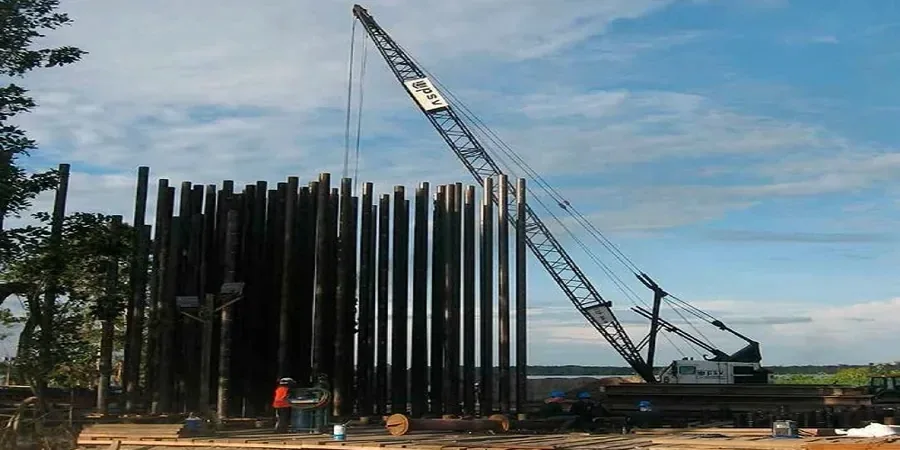
A single static load test on a driven pile in Oceanside coastal sands can confirm capacity with 30% less uncertainty than relying solely on driving formulas.
Method and coverage
Regional considerations
In the downtown Oceanside area, near the pier, loose fill and old channel deposits create a risk of negative skin friction as the fill settles over time. Up in the hills of Oceana Drive, the colluvium over weathered granite can cause pile tip refusal at shallow depths, forcing the design to switch to end-bearing only. The contrast between these two zones makes a single approach unreliable. A thorough driven pile design in Oceanside must evaluate both scenarios: downdrag in the lowlands and premature refusal in the highlands. We have encountered piles that met the driving criterion at 8 meters but failed the static test due to soil relaxation — a phenomenon typical of dense silty sands after driving ceases.
Standards that apply
IBC 2024 – Chapter 18 (Soils and Foundations), ASTM D4945-17 (Static Load Testing of Piles), ASCE 7-22 (Minimum Design Loads, including seismic), ACI 543R-12 (Design, Manufacture, and Installation of Concrete Piles)
Complementary services
Pile Capacity Analysis
We calculate ultimate and allowable capacities using static formulas (Meyerhof, API) and dynamic formulas (ENR, Gates), calibrated with site-specific SPT data from Oceanside boreholes.
Wave Equation Analysis
Using GRLWEAP, we simulate the hammer-pile-soil system to predict driving stresses, blow counts, and set criteria before mobilization, reducing risk of pile damage.
Static Load Test Supervision
Our engineers oversee reaction-frame or bi-directional load tests on driven piles in Oceanside, interpreting the load-settlement curve to validate design assumptions and meet code requirements.
Typical parameters
Top questions
How much does driven pile design cost in Oceanside?
For a typical project in Oceanside, the engineering design and analysis phase ranges between US$1,260 and US$3,920. This includes capacity calculations, wave equation modeling, and a preliminary report. The final cost depends on the number of pile types, load test requirements, and site accessibility.
What is the difference between N-SPT and pile capacity in Oceanside soils?
N-SPT measures the resistance of soil to a split-spoon sampler, while pile capacity integrates that resistance over the entire shaft and tip. In Oceanside's sandy terraces, an N-value of 30 to 50 usually indicates dense sand suitable for end-bearing, but skin friction can be 40% higher in the same soil due to the lateral earth pressure coefficient. We do not use N-values directly for capacity; we apply empirical correlations like Meyerhof or Schmertmann.
When should I use a static load test instead of a dynamic test for driven piles in Oceanside?
Use a static load test when the pile supports more than 500 kN per pile or when the geotechnical conditions are variable, as in the transition zone between the coastal plain and the foothills. Dynamic testing with a PDA is faster and cheaper, but it does not directly measure settlement under sustained load. For Oceanside projects near the San Luis Rey River, where scour is a risk, we always recommend at least one static load test per site.