Oceanside grew rapidly after the 1960s, transforming from a quiet beach town into a city of nearly 180,000 residents. That expansion pushed development onto former marshlands and alluvial plains where the San Luis Rey River meets the Pacific. Much of the soil here is soft, saturated clay and silt — exactly the kind of ground that takes years to settle naturally. That is why prefabricated vertical drain design has become a core part of geotechnical strategy in Oceanside. Instead of waiting for decades, we install wick drains to shorten the drainage path and accelerate consolidation by months. Before finalizing any PVD layout, we always perform a granulometry analysis to characterize the fines content, and we check the natural moisture profile with undisturbed sampling to calibrate the consolidation model.
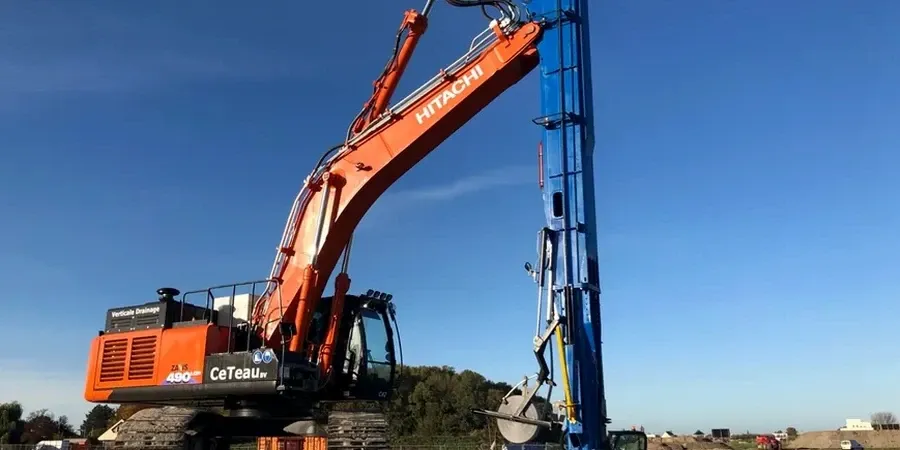
Spacing prefabricated vertical drains at 1.5 m can cut consolidation time from 5 years to 6 months in Oceanside's soft clays.
Method and coverage
Regional considerations
A typical PVD rig in Oceanside is a tracked mast unit that pushes the drain mandrel into the ground using static force and vibration. We see the machine working along alignments near the 76 freeway or Camp Pendleton border, where the soil profile can shift from sand to clay abruptly. The main risk during installation is smear — the remolding of the soil around the mandrel, which reduces horizontal permeability. If smear is not accounted for in the prefabricated vertical drain design, the actual consolidation rate can be 30% slower than predicted. We mitigate this by using a slim mandrel (no more than 130 mm wide) and by specifying a filter sleeve with adequate discharge capacity. Another frequent issue in Oceanside is artesian pressure from deeper aquifers; we run piezocone tests before installation to detect those zones and adjust the drain termination depth accordingly.
Standards that apply
ASCE 7-22 (Minimum Design Loads, Section on Surcharge and Consolidation), ASTM D6918-18 (Standard Test Method for Geocomposite Drainage), IBC 2021 Chapter 18 (Soils and Foundations, Section 1804)
Complementary services
Consolidation Modeling & Drain Layout
We run Barron and Hansbo solutions using site-specific soil parameters to determine drain spacing, depth, and required surcharge. Our models incorporate smear effects and well resistance to deliver realistic time-settlement curves.
Installation Supervision & QA/QC
Our technicians monitor mandrel penetration rates, verify drain continuity, and collect filter samples for discharge capacity testing. We document every drain location and depth for as-built records.
Post-Installation Settlement Monitoring
We install settlement plates, piezometers, and inclinometers to track real-time consolidation progress. Data is reviewed weekly, and we adjust the surcharge schedule if pore pressures deviate from the model.
Typical parameters
Top questions
How long does it take for prefabricated vertical drains to work in Oceanside's soil?
In typical Oceanside soft clays with 1.5 m spacing, you can reach 90% consolidation in 4 to 8 months, compared to 3 to 5 years without drains. The exact time depends on the clay's coefficient of consolidation and the surcharge load applied.
What is the typical cost range for prefabricated vertical drain design in Oceanside?
For a standard commercial or residential project in Oceanside, the engineering design and consultation fee ranges from US$850 to US$2,890. Installation costs are separate and depend on drain spacing, depth, and total quantity.
Do prefabricated vertical drains work in sandy soils?
They are less effective in sands because sand already drains quickly. PVDs are designed for low-permeability clays and silts where excess pore pressure dissipates slowly. In Oceanside, we use them mainly in the floodplain deposits and estuarine clays.
Can PVDs be installed near the ocean or in areas with high groundwater?
Yes, the installation rig works fine in saturated conditions. However, high groundwater can cause the drain mandrel to push water sideways, potentially affecting adjacent drains. We mitigate this by sequencing the installation from one side of the site to the other and by using a vacuum-assisted surcharge when needed.