Oceanside sits on a coastal terrace underlain by Pleistocene-age terrace deposits and recent alluvium from the San Luis Rey River, resulting in a varied subsurface profile that includes sands, silty clays, and occasional gravel lenses. Groundwater typically lies between 10 and 25 feet below grade, though seasonal fluctuations can bring it closer to the surface near the river corridor. These conditions directly influence the structural design of flexible pavements, requiring site-specific characterization of subgrade strength, drainage behavior, and compaction criteria. Before finalizing any pavement section, a thorough investigation of the soil's California Bearing Ratio (CBR) and resilient modulus is essential, and we often combine this with a study of soil mechanics to understand the full profile. The combination of marine-influenced deposits and seismic Zone 4 requirements under the California Building Code means that flexible pavement design in Oceanside must account for both traffic loads and potential dynamic loading from earthquakes.
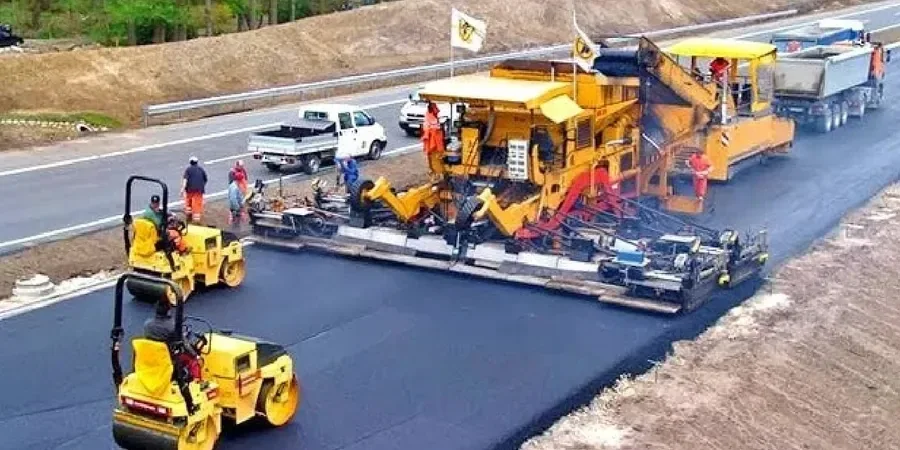
Expansive clay layers near the coast require soaked CBR and swell testing to prevent differential heave and premature cracking in flexible pavement structures.
Method and coverage
Regional considerations
The primary risk in Oceanside flexible pavement projects stems from inadequate subgrade preparation on variable alluvial soils. If a contractor places asphalt over a poorly compacted sandy layer without verifying density through nuclear gauge testing, the pavement can rut within months under heavy truck traffic serving new developments. Another common issue is ignoring the effect of perched water tables after winter rains, which can soften the subgrade and cause pumping of fines through the base course. We address these risks by requiring dynamic cone penetrometer (DCP) testing at 50-foot intervals along the alignment, coupled with moisture monitoring during compaction. In seismic areas like Oceanside, liquefaction of loose saturated sands beneath the pavement structure during a major event can lead to total loss of support, making it critical to evaluate soil liquefaction potential using the NCEER method before finalizing the design.
Standards that apply
AASHTO Guide for Design of Pavement Structures (1993), ASTM D1883-21 (CBR Test), ASTM D1557-12 (Modified Proctor), California Test 301 (Resilient Modulus), Caltrans Highway Design Manual Chapter 630
Complementary services
Subgrade Investigation & CBR Testing
Boreholes and test pits to classify soils, measure in-situ moisture, and determine soaked CBR values for design input. Includes Atterberg limits and grain size analysis to assess plasticity and drainage.
Pavement Structural Section Design
Calculation of asphalt concrete and aggregate base thicknesses using AASHTO 1993 methodology, calibrated with local traffic counts and Caltrans district background. Deliverables include cross-sections and material specifications.
Compaction Control & Quality Assurance
Field density testing via nuclear gauge and sand cone, moisture content verification, and proof-rolling observations to ensure the subgrade and base meet the project's compaction requirements before paving.
Typical parameters
Top questions
What soil tests are essential for flexible pavement design in Oceanside?
The most critical tests are the soaked California Bearing Ratio (CBR) per ASTM D1883, the modified Proctor compaction test (ASTM D1557), and the Atterberg limits (ASTM D4318) to identify expansive clays. For seismic areas, liquefaction assessment using the NCEER method is also recommended when loose sands are present.
How much does a flexible pavement design study typically cost in Oceanside?
For a typical subdivision or commercial parking lot project, the cost ranges between US$1,820 and US$5,170 depending on the number of test pits, laboratory tests, and the complexity of the traffic analysis. Larger arterial road projects with multiple alignments may exceed this range.
What is the difference between flexible and rigid pavement for Oceanside conditions?
Flexible pavement uses an asphalt surface over granular base layers, distributing loads through the structure, while rigid pavement uses a concrete slab that bridges weaker subgrades. In Oceanside's clay-rich soils, flexible pavement is often preferred because it can better accommodate differential movement, but it requires a thicker base section to prevent rutting.
How do seasonal rains affect flexible pavement construction in Oceanside?
Winter rains between November and March can saturate the subgrade, making compaction difficult and reducing CBR values by 30% or more. Construction should be scheduled during dry months, or the contractor must use lime treatment to dry and stabilize the subgrade before placing the base course.
What structural number (SN) is typical for an Oceanside local road?
For a local residential street carrying fewer than 100,000 ESALs over 20 years, a structural number of 2.5 to 3.5 is common, translating to about 4 inches of asphalt concrete over 8 inches of aggregate base. Collector roads with higher traffic require SN values of 4.0 to 5.0.