Oceanside's coastal location subjects its alluvial and terrace deposits to fluctuating groundwater levels and cyclic wet-dry seasons. The shallow water table near the San Luis Rey River channel can trigger consolidation in low-plasticity silts and loose sands, making settlement analysis a critical step before slab-on-grade or shallow foundation construction. We combine field data from SPT borings with laboratory consolidation tests to model immediate and primary consolidation settlement, referencing IBC Chapter 18 for allowable differential movement criteria. Before finalizing the foundation layout, the team often cross-checks results with a placa de carga to verify modulus of subgrade reaction, or a permeabilidad en laboratorio when drainage conditions affect consolidation rates.
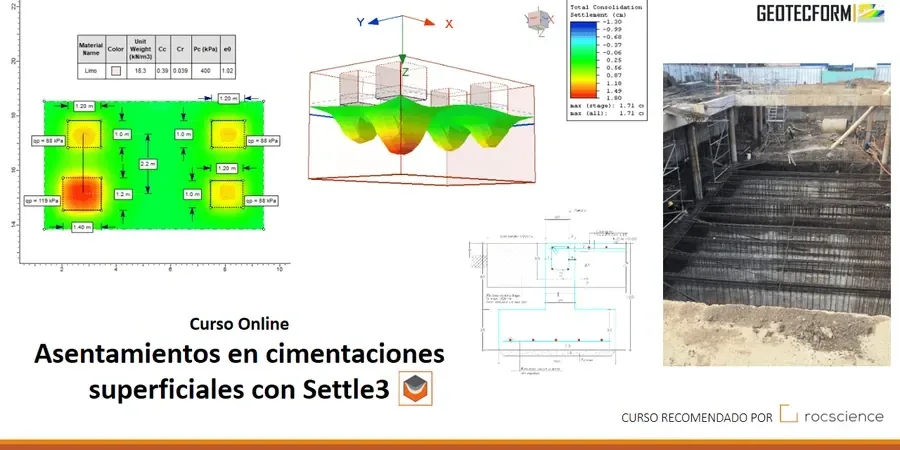
Primary consolidation in Oceanside's silty clays can account for 60-70% of total settlement within the first year after load application.
Method and coverage
Regional considerations
A common oversight in Oceanside is assuming uniform soil behavior across a single building footprint. We often encounter buried stream channels or old dune lenses that produce highly variable compressibility within a 10 m radius. Ignoring that variability can lead to differential settlement exceeding 40 mm, which cracks slabs and misaligns utilities. To mitigate this, we recommend a grid of borings spaced no more than 15 m apart in the proposed building area, with consolidation tests on samples from each distinct layer. The risk is real — several local warehouses have required slab jacking within two years of construction due to underestimated settlement in heterogeneous fills.
Standards that apply
ASTM D2435-11 (one-dimensional consolidation), ASTM D1586-18 (SPT), IBC 2021 Chapter 18 (foundations), ASCE 7-22 (load combinations)
Complementary services
Consolidation Testing (ASTM D2435)
Step-loading oedometer tests on undisturbed tube samples to determine compression index, preconsolidation pressure, and coefficient of consolidation. Results are calibrated against local geologic history to distinguish normally consolidated from overconsolidated deposits.
Settlement Monitoring Plan
Installation of surface settlement plates and deep rod extensometers at critical locations, with weekly readings during and after construction. Data is compared against predicted time-rate curves to trigger corrective measures if movements exceed 1.5 times the forecast.
Typical parameters
Top questions
How long does a full settlement analysis take for a typical Oceanside residential project?
From sample collection to final report, expect 10 to 15 working days. Consolidation tests require at least 5 days for multi-stage loading, plus additional time for SPT data integration and modeling.
What is the typical cost range for a settlement analysis in Oceanside?
For a standard 4-boring investigation with consolidation tests on two samples, the cost ranges between US$720 and US$1,800. Larger commercial sites with six or more borings and additional testing (e.g., triaxial) may reach the upper end of that range.
Does the high water table in Oceanside affect the accuracy of settlement predictions?
Yes, significantly. Saturated silts and fine sands can exhibit rapid initial settlement under undrained conditions. We account for this by running both drained and undrained analyses, and by measuring pore pressure dissipation during consolidation testing to refine the time-rate curve.