We worked on a hillside project near the San Luis Rey River where the cut slope reached 9 meters. The owner wanted a retaining wall that would hold the fill behind a new parking lot. We ran borings and found loose sands with a high water table just 3 meters down. That changed the wall design completely. A conventional gravity wall would have needed a massive footing. Instead we proposed a cantilevered reinforced concrete wall with a drainage blanket. Before finalizing the retaining wall design, we performed a plate load test to confirm the bearing capacity at the base elevation. The wall has held without movement for four rainy seasons.
Seasonal moisture changes soil stiffness in Oceanside. Our retaining wall design models unsaturated behavior to get real earth pressures.
Method and coverage
Regional considerations
Coastal fog and winter rain saturate the sandy soils near the ocean. That raises pore water pressure behind the wall. If the drainage layer is undersized, hydrostatic pressure can double the lateral load on the wall. We have seen walls in Oceanside fail because the backfill was placed without a filter fabric and the fines clogged the weep holes. Another risk is marine corrosion. The chloride content in coastal air attacks steel reinforcement. We specify epoxy-coated rebar or galvanized anchors. For walls taller than 15 feet, we recommend soil nails or tiebacks anchored into competent strata below the loose sand.
Standards that apply
AASHTO LRFD Bridge Design Specifications (9th Edition, 2020), ASCE 7-22 (Minimum Design Loads for Buildings, Seismic), ASTM D2487-17 (Classification of Soils for Engineering Purposes), ACI 318-19 (Building Code Requirements for Structural Concrete)
Complementary services
Gravity and Cantilever Wall Design
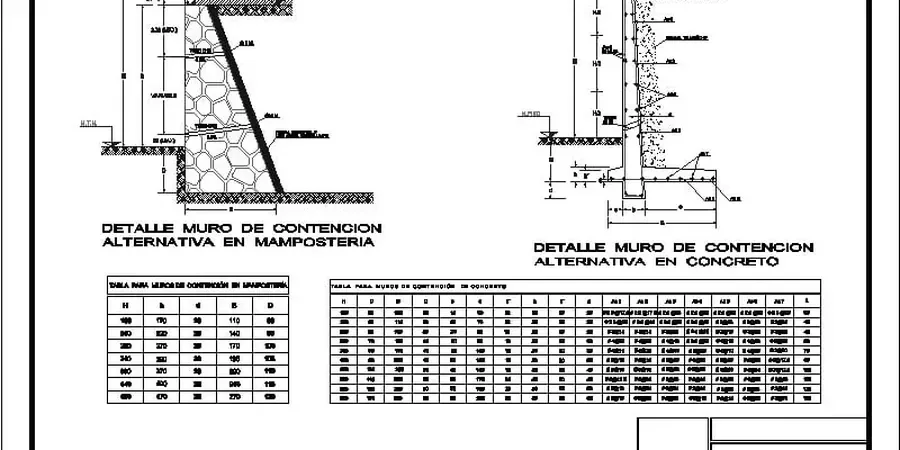
We size the base width, toe length, and stem thickness to resist sliding, overturning, and bearing failure. All checks follow AASHTO LRFD with load factors for dead, live, earth, and seismic loads. We include a drainage design with perforated pipe and gravel blanket.
Soil Nail and Anchored Wall Design
For constrained sites or tall cuts, we design soil nail walls with grouted tendons and shotcrete facing. We verify bond strength through pullout tests on sacrificial nails. The design includes corrosion protection per FHWA guidelines.
Typical parameters
Top questions
What is the typical cost range for a retaining wall design in Oceanside?
The cost for a full geotechnical investigation and wall design report in Oceanside ranges between US$1.040 and US$3.810. The final price depends on the wall height, number of borings, and lab testing required.
How deep do you drill for a retaining wall investigation?
We drill to a depth of at least 1.5 times the wall height, or until we reach competent bearing strata. For a 12-foot wall, that means borings around 18 to 20 feet deep. We log soil type, blow counts, and groundwater conditions at each foot.
Do you include seismic design in the wall report?
Yes. Oceanside is in Seismic Design Category D per the IBC. We calculate the pseudo-static seismic coefficient using ASCE 7 and check the wall for sliding and overturning under earthquake loads. The report includes the site class and spectral accelerations.
How long does it take to get a retaining wall design report?
The fieldwork takes one to two days. Lab testing adds another week. The analysis and report writing take three to five business days. Total turnaround is usually two to three weeks from the day we start drilling.