The sandy coastal terraces near the Oceanside Pier drain fast, but the clay-rich soils around the San Luis Rey River valley behave completely differently. That contrast defines why we run site-specific infiltration tests here. A double-ring infiltrometer reading on the beach side might show 15 cm/h, while just two miles inland the rate drops below 2 cm/h. Before designing any stormwater basin or septic system, you need real numbers. We combine the permeability field test with a detailed soil classification to match the right infiltration curve. Oceanside's variable geology demands this precision.
A single infiltration test can mean the difference between a functional drainage system and a flooded property after a winter storm in Oceanside.
Method and coverage
Regional considerations
Oceanside sits in a Mediterranean climate with wet winters and dry summers. The coastal fog and marine layer keep the near-surface soil moist year-round, which can inflate infiltration rates if you test during a dry spell. We always check antecedent moisture conditions and correlate with the local rainfall record. Testing right after a storm gives a different result than testing in August. That seasonal swing matters for designing detention basins. If you design for a dry-season rate, the system will underperform in winter. Our team accounts for this and adjusts recommendations accordingly.
Standards that apply
ASTM D3385-18 (Infiltration Rate of Soils in Field Using Double-Ring Infiltrometer), IBC 2021 Chapter 18 (Soils and Foundations), California Stormwater Quality Association (CASQA) BMP Handbook
Complementary services
Double-Ring Infiltrometer Testing
Full field setup with 300/600 mm rings, constant-head or falling-head protocols, and real-time data logging. Suitable for bioretention, infiltration basins, and pervious pavement designs.
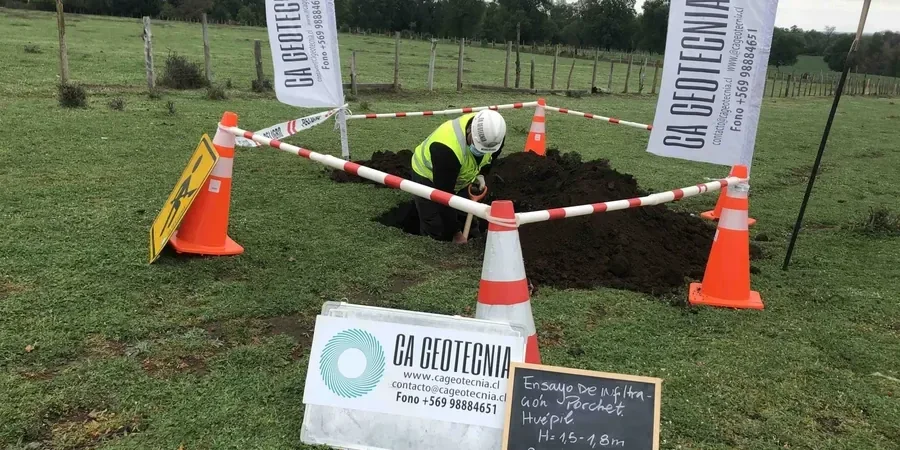
Porchet Test (Single-Ring)
Simplified single-ring method for preliminary assessments or small-scale projects. Faster execution, lower cost, but less accurate for layered soils. We recommend it only for initial screening.
Infiltration Analysis & Report
Comprehensive report including corrected infiltration rates, seasonal adjustment factors, and design recommendations for stormwater management. Includes soil classification per ASTM D2487.
Typical parameters
Top questions
How much does an infiltration test cost in Oceanside?
For a standard double-ring infiltrometer test including mobilization within Oceanside, the typical range is between US$330 and US$460. Costs vary with depth of testing, number of test locations, and access conditions.
What's the difference between a Porchet test and a double-ring test?
The Porchet test uses a single ring and measures lateral plus vertical flow together. The double-ring infiltrometer isolates vertical flow using an outer buffer ring. For Oceanside's layered soils, the double-ring is far more reliable for design.
Do I need an infiltration test for a residential septic system in Oceanside?
Yes. The County of San Diego requires percolation testing for new septic systems. We perform the double-ring test per ASTM D3385 to meet Title 22 requirements. Oceanside's coastal groundwater levels also need careful evaluation.
Can you test during the rainy season?
We can, but the results will reflect saturated conditions. For design purposes we prefer testing during the dry season (May–October) and then applying a correction factor for winter storms. We always note antecedent moisture in the report.