ASTM E1195 and IBC Chapter 18 govern plate load testing for shallow foundations. In Oceanside, where the coastal geology delivers stiff to medium-dense sands over a shallow water table, the PLT provides a direct, on-site measure of bearing capacity and immediate settlement. We load a steel plate against the soil while recording deflection with calibrated dial gauges. For projects requiring deeper soil characterization, we pair this test with a granulometry analysis to understand particle size distribution and its effect on compaction.
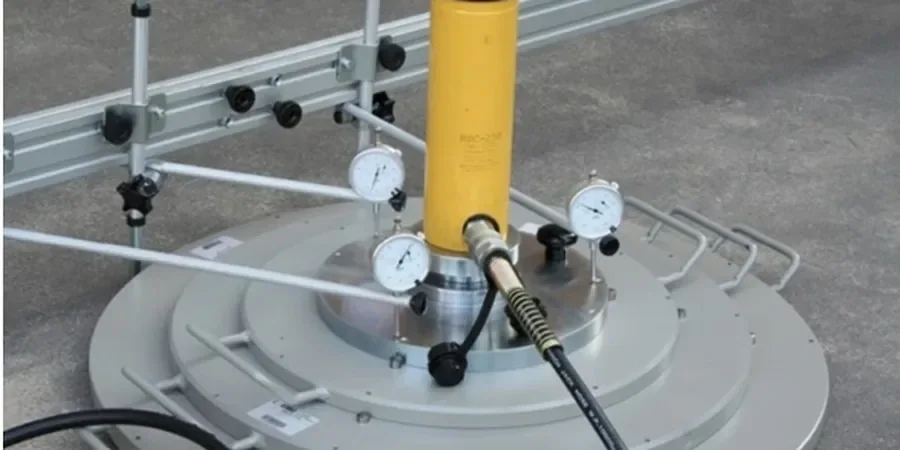
A single plate load test at 30 inches can predict bearing capacity within 15% of full-scale footing behavior for uniform sands.
Method and coverage
Regional considerations
The marine layer and fog that roll into Oceanside most mornings keep the near-surface sands damp, which can mask the true dry density of the soil. If you test on a wet morning and then pour a footing in the afternoon sun, the soil may dry and shrink, creating a gap under the footing. We recommend scheduling the PLT for late morning after the fog has lifted and the top 2 inches have had time to drain. That single precaution avoids a common cause of post-construction settlement in coastal San Diego County.
Standards that apply
ASTM D1194-94 (Standard Test Method for Bearing Capacity of Soil for Static Load and Spread Footings), IBC 2021 Section 1806 (Allowable Load-Bearing Values of Soils), Caltrans Highway Design Manual Chapter 660 (Foundations and Retaining Walls), ASCE 7-22 (Minimum Design Loads and Associated Criteria for Buildings)
Complementary services
Shallow Foundation Verification
For isolated footings and continuous strip footings on sand or silty sand. We perform a single-cycle load test to confirm the design bearing pressure and measure immediate settlement. Results are delivered within 48 hours with a signed report.
Slab-on-Grade k-Value Determination
For warehouse slabs, parking lots, and residential slabs. We run a plate load test at the subgrade elevation and compute the modulus of subgrade reaction (k). The report includes a recommendation for slab thickness per ACI 360.
Typical parameters
Top questions
How deep does a plate load test actually test the soil?
The test influences the soil to a depth of about 1.5 to 2 times the plate diameter. With a standard 30-inch plate, you get data from roughly the top 4 to 5 feet. For deeper bearing layers, you need a larger plate or a complementary SPT boring.
What is the typical cost for a plate load test in Oceanside?
Between US$940 and US$1,410 for a single test on a typical residential or light commercial site. The range depends on site access, plate size, and whether you need a report with full settlement curves. Volume discounts apply for multiple test locations.
Can I run a PLT on a wet or rainy day?
Not recommended. Saturated sand will shear prematurely and give you a false low bearing capacity. We require the test area to be dry to at least the plate depth. If rain is forecast, we reschedule to avoid wasted mobilization fees.
What is the difference between a PLT and a CBR test?
The CBR (California Bearing Ratio) measures shear strength of compacted soils in a lab mold or in place with a small plunger. The PLT measures actual load-settlement behavior under a large plate. For footing design, the PLT is more representative; for pavement design, CBR is standard.