Oceanside sits on a coastal plain underlain by the San Luis Rey River valley, with groundwater levels fluctuating between 5 and 20 feet depending on season and tide. Understanding these conditions is critical before excavation or foundation work. Electrical resistivity and VES surveys map lateral and vertical changes in subsurface resistivity, revealing clay lenses, saltwater intrusion, and bedrock depth. This non-invasive method provides continuous profiles without drilling, making it ideal for large-area reconnaissance. The data directly inform subsequent intrusive investigations, such as a study of soil mechanics to correlate resistivity with soil type, or a plate load test where bearing capacity is in question.
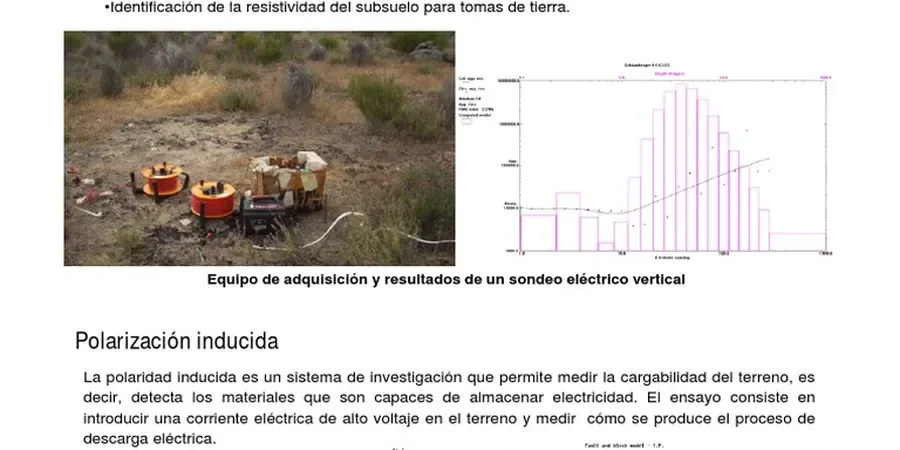
Resistivity surveys catch lateral soil variability that standard borings miss, reducing the risk of unanticipated conditions during excavation.
Method and coverage
Regional considerations
ASCE 7-22 requires site-specific geotechnical parameters for Seismic Design Categories C through F, and Oceanside falls under SDC D due to its proximity to the Elsinore fault zone. Electrical resistivity surveys help classify the site profile by mapping soft alluvium versus firm Pleistocene terrace deposits. Without this data, a shallow sand layer could be misinterpreted as firm ground, leading to under-designed foundations or excessive settlement claims. The California Geological Survey's Seismic Hazard Zone maps show liquefaction potential in the river valley, and resistivity directly identifies saturated loose sands that are prone to cyclic failure.
Standards that apply
ASTM D6431-18 (Standard Guide for Using the Direct Current Resistivity Method), ASCE 7-22 (Minimum Design Loads – Site Classification), California Geological Survey Note 48 (Checklist for Geotechnical Reports), ASTM G57-20 (Field Measurement of Soil Resistivity – Wenner array)
Complementary services
2D Resistivity Tomography (ERT)
Multi-electrode array (48 to 96 electrodes) covering profiles up to 500 m long. Ideal for mapping paleochannels, fault zones, and groundwater contamination plumes in the San Luis Rey floodplain. Results are delivered as 2D cross-sections with interpreted lithology.
Vertical Electrical Sounding (VES)
Single-point depth sounding using expanding electrode spacing. Best for identifying layer thickness and resistivity contrast in layered alluvium, such as distinguishing clay from sand or locating the fresh-saline water interface near the coast. Typically performed at 5–10 stations per site.
Typical parameters
Top questions
How deep can a VES survey reach in Oceanside's alluvial soils?
With electrode spacing up to 200 m, VES typically reaches 40–60 m in the San Luis Rey River valley alluvium. Deeper penetration requires longer lines or a 2D ERT array, but 40 m covers most foundation and groundwater studies in the area.
What is the typical cost range for an electrical resistivity survey in Oceanside?
A standard VES survey with 10 soundings and a 2D profile costs between US$640 and US$1,030 for a residential lot. Larger sites with multiple ERT lines can go higher. The exact price depends on access, number of stations, and reporting detail.
Can resistivity surveys detect saltwater intrusion in coastal Oceanside?
Yes. Saltwater has very low resistivity (0.2–5 ohm-m) compared to fresh groundwater (10–100 ohm-m). This contrast makes VES and ERT effective for mapping the freshwater-saltwater interface, especially along the coast near the Oceanside Pier and Buena Vista Lagoon.
Do you need permits to run resistivity surveys on private property in Oceanside?
No. Electrical resistivity is non-invasive and uses low DC current (typically < 50 mA). No drilling or ground disturbance occurs, so no city permit is required. However, we do notify neighbors when working near property lines to avoid accidental wire disturbance.